MKM for Museums & Libraries · 02 — What changes for the visitor and the reader

The holdings don't change. The paths through them do.

Once concepts, objects, people and evidence are modelled as a graph, a route through the collection becomes a question rather than a construction project — and can be recomposed endlessly from scholarship you already own. In a gallery that route is a visit. In a reading room it is an answer that finally crosses the catalogue, the archive and the digital repository in one move.

Same exhibit, same evening, three visitors
Standing in front of the same object

This is not three exhibitions. It is one concept, with depth held as a property and different relationships followed for each visitor. Illustrative example.

BEFORE THE ONTOLOGY + KNOWLEDGE GRAPH
THE ASTRONOMY GALLERY Solar system display Visitor THE ONE LINE THAT CROSSES THE KNOWLEDGE LAYER · LINES THE SCREEN NEVER SHOWS Seasonal star positions Inscription at the base Building of the shrine Local lunar calendar The local-history room SETS THE DATE SAME YEAR
Illustrative. The visitor sees only what is on the screen. The line of knowledge that would make it mean something to them sits two rooms away, and has never been written down anywhere. The knowledge layer is where those lines get recorded — and where each of them can be traced back.
AFTER THE ONTOLOGY + KNOWLEDGE GRAPH
THE SAME ROOM · ONCE THE KNOWLEDGE IS CONNECTED Visitor Pole star Calendar The shrine EVERY STEP CARRIES ITS SOURCE A route assembled for this visitor COME BACK, GET A DIFFERENT ONE ASKS ANSWER + EVIDENCE THE KNOWLEDGE LAYER · OWNED BY THE INSTITUTION · EVERY LINE TRACEABLE Seasonal star positions 2 INDEPENDENT SOURCES Inscription at the base PHOTOGRAPH OF THE STONE Local lunar calendar LOCAL RECORDS Building of the shrine EXCAVATION REPORT THE HEAVIER LINE IS THE ROUTE THAT ANSWERED THIS QUESTION A PERSONAL KNOWLEDGE ASSISTANT ASSEMBLES THE ANSWER FROM THE LAYER AND RETURNS IT WITH ITS EVIDENCE
After the knowledge is connected. The holdings did not change. What changed is the route of knowledge through them. The visitor’s question is answered out of the layer, every step carrying its source — and the next visitor, asking something else, gets a different route through the same collection.
THREE VISITORS · ONE OBJECT · THREE DEPTHS

Below: an astronomy exhibition where visitors use an AR app to follow the lines of knowledge that connect the movement of the stars to local scholarship — each of them at the depth their own understanding and interest allow.
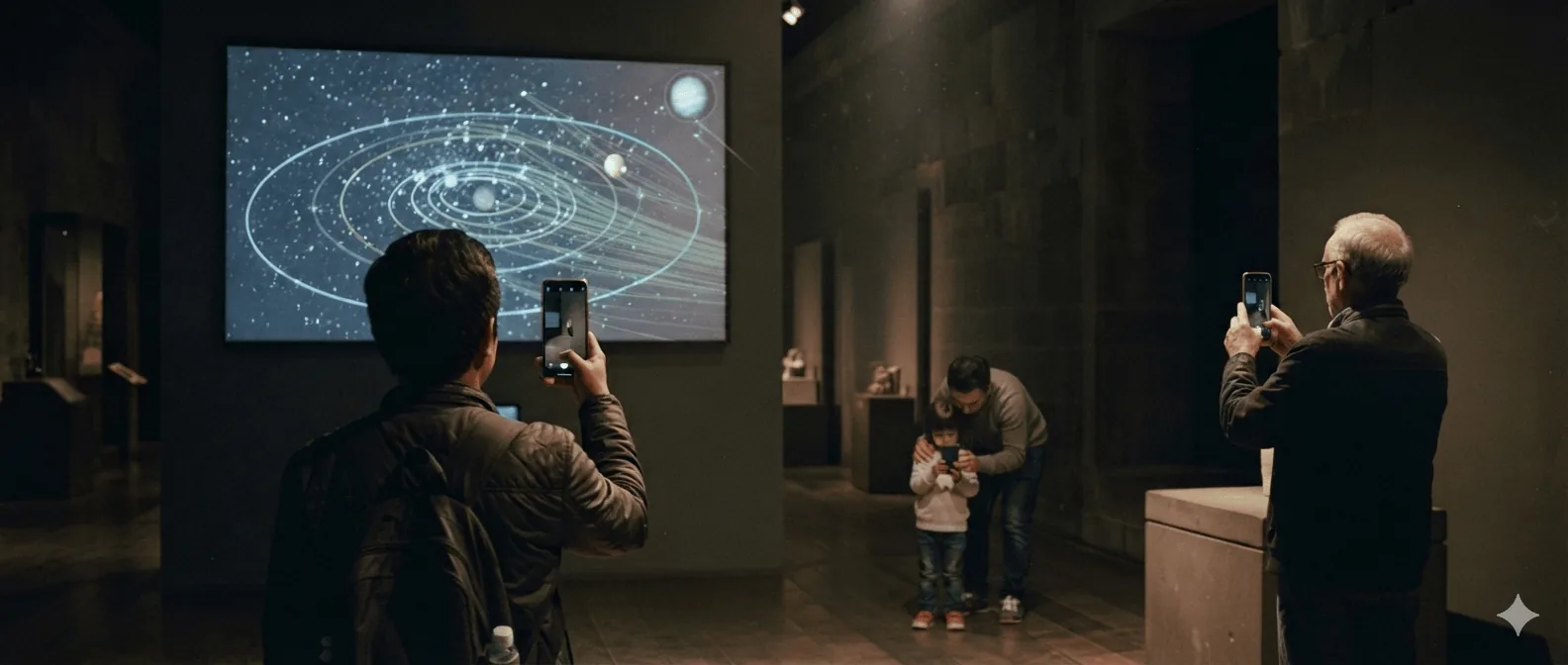
Three visitors in an astronomy gallery, each looking through their own phone
A CHILD WHO CANNOT READ YET
One large moon, and a face beginning to cover it. Two threads. What they take home is something they can repeat in the car.
A CURIOUS ADULT
The eclipse lintel, joined to the star map on the wall. Five threads. What they take home is a connection they did not know existed.
SOMEONE WHO ALREADY KNOWS
Plus the inscription, the excavation report and the lunar calendar. Fourteen threads. What they take home is the evidence under the conclusion — and what is still disputed.
Illustrative. Same room, same object — and three different things carried out of it. The knowledge layer holds depth as a property and chooses the route for the person in front of it — so one exhibition can answer what each visitor actually came with.
Experience 01

A different thread every visit

The permanent collection stays permanent — but the route through it can change monthly, entered through trade, through repair and reuse, through a single decade.

Experience 02

The stored collection joins in

Most of what you hold will never fit in a gallery. Connected, those objects still take part — as the thing the object in front of you turns out to be related to.

Experience 03

Every question becomes an asset

Questions the collection can't answer are recorded against the item. Repeated often enough, they become a research agenda ranked by real public curiosity.

Experience 04 · reading room

A reference answer that shows its working

A reader's enquiry returns your own holdings, your own finding aids and your own subject expertise — with the trail attached — instead of a ranked list that stops at whatever happens to be catalogued in one system.

And the guardrail that makes it safe to do at all
A visitor-facing AI is not an exhibit. Exhibitions close. Answers don't.

Every answer it gives is an institutional statement, issued in your name, hundreds of times a day, without a curator reading a word of it first. An institution that holds society's knowledge cannot let statements without provenance go out under its name — and that obligation doesn't lapse because the statement was generated rather than written.

Which is why the layer comes first, and why the rules on it are strict: sensitive material stays inside your boundary, contested attributions stay contested, and only a curator promotes a claim to a fact. Prepared properly, the constraint becomes the feature — an AI that is structurally incapable of overclaiming is something no general assistant can offer.

08 — Start the conversation

If this is close to what you have been thinking, let's find a time.

90 minutes. Bring your curators or librarians, and one question your institution couldn't answer.

Received. We'll reply within two business days to find a time.

Or write directly — hello@neogens.co

Previous
MKM for Museums & Libraries
Next
03 · What leadership looks like