1.The question about AI has been asked. The structure to support the answer has not yet been built.
In 2026, UNESCO and ICOM launched a global survey of how museums are using artificial intelligence. The significance lies not only in the figures the report will publish, but in the way the question is framed. The sector's leading bodies are no longer asking whether museums should use AI. They are asking what museums need in order to use it responsibly.
Contemporary research presents a concerning picture. Roughly 52% of surveyed museums already use AI in some form, while another 11% do not even know whether their staff are using it. Only 9% have a formal charter or policy. Technology has clearly moved faster than governance.
At the same time, the American Alliance of Museums found that over 70% of the general public do not want museums to use AI in developing exhibitions, and 43% oppose its use even for emails or website copy.
These findings are revealing. We interpret them as evidence that the public still places trust in institutions such as museums, and does not want that trust entangled with a technology whose reliability remains uncertain.
Taken together, the three perspectives show that the issue is no longer a choice between using AI and not using it. The issue is how museums preserve trust while the technology enters the institution's knowledge-making processes.
The answer is not simply to use less AI. Institutions must be able to show how trustworthy the evidence behind every AI-generated answer is.
2.The problem now has an official name
In February 2026, the Library of Congress published Content Authenticity and Provenance in the Age of Artificial Intelligence: A Call-to-Action for the LAMs Community. Its argument is uncomfortable and correct: the sector's longstanding provenance practices now have to extend into machine-assisted workflows.
Provenance is not a new idea that AI has forced on the sector. Libraries and museums developed the practice. A catalogue record carries which agency created it, who modified it, and when. An object register carries the chain of hands it passed through. Ask how we know, and someone can walk you back.
All of it rests on accountability. AI has not replaced that process. It has entered it one step at a time, and it is already inside:
- Description. At the Nasher Museum of Art, a chatbot produced fluent catalogue prose that called works on paper sculptures.
- Enrichment. The US National Archives used AI to extract names from census records. A name extracted wrongly becomes exactly as searchable as one extracted correctly.
- Discovery. Research generating web-archive metadata with GPT-4o found output usable in parts, but too uneven to release without human review.
- Cataloguing machine-made works. The Library of Congress has published guidance on cataloguing resources generated using AI software.
The record that comes out looks like the records that came before it. The field naming the responsible agency still names your institution. What that name used to guarantee is no longer guaranteed.
A standard such as C2PA can record what happened to a file; it does not by itself show which evidence supports each sentence in a record. A tool is only as good as the material and controls around it. And an institution benefits from independent corroboration: "a second pair of hands" means a separate source, reviewer, or authority capable of checking the claim.
OCLC's working group on AI in metadata workflows named three recurring failure modes: hallucinations that introduce false information, inconsistent outputs from identical inputs, and confidence scores that do not reliably represent output quality.
These problems should not be assumed to disappear simply because the underlying models improve. The practical response is to give the model a substrate that can be inspected, challenged, and corrected.
3.What this looks like when it goes wrong
At the Nasher, confident language renamed or misclassified objects without signalling uncertainty. At the Mariners' Museum, a curator-led test found specialist errors across three AI models - and useful results when a curator directed and checked the work.
A wrong catalogue record and a right one can look exactly the same. Visitors, researchers, and search engines cannot distinguish them from fluent text alone.
4.The precedent: what Yale already paid to learn
Between 2018 and 2023, Yale built LUX, a cross-collection discovery platform spanning more than 41 million records from four major collections, reconciled and enriched from external sources and built on Linked Open Usable Data, Linked Art, and IIIF.
LUX is powerful evidence that a cross-domain cultural heritage knowledge graph is achievable. It is also a warning. The Oxford e-Research Centre summarised a central lesson as "Semantic Completeness vs Data Usability" - the trade-off between an abstract model's purity and the resulting data's practical value.
A theoretically complete model that does not serve what the institution is actually for is a very expensive way to produce a diagram.
The ontology has to begin with the mission, not with the standard.
The question "what is this institution for, and what must it be able to say with authority?" is one only a director and their curators can answer. No vendor can answer it for you, and no model can infer it from the data alone.
Erin Canning's work on critical cataloguing terminology reinforces the point: choices about colonial, outdated, or harmful terms - and about who has authority to name - are not neutral. Delegating the knowledge structure to a statistical model is delegating interpretive authority. That is a mission decision wearing technical clothing.
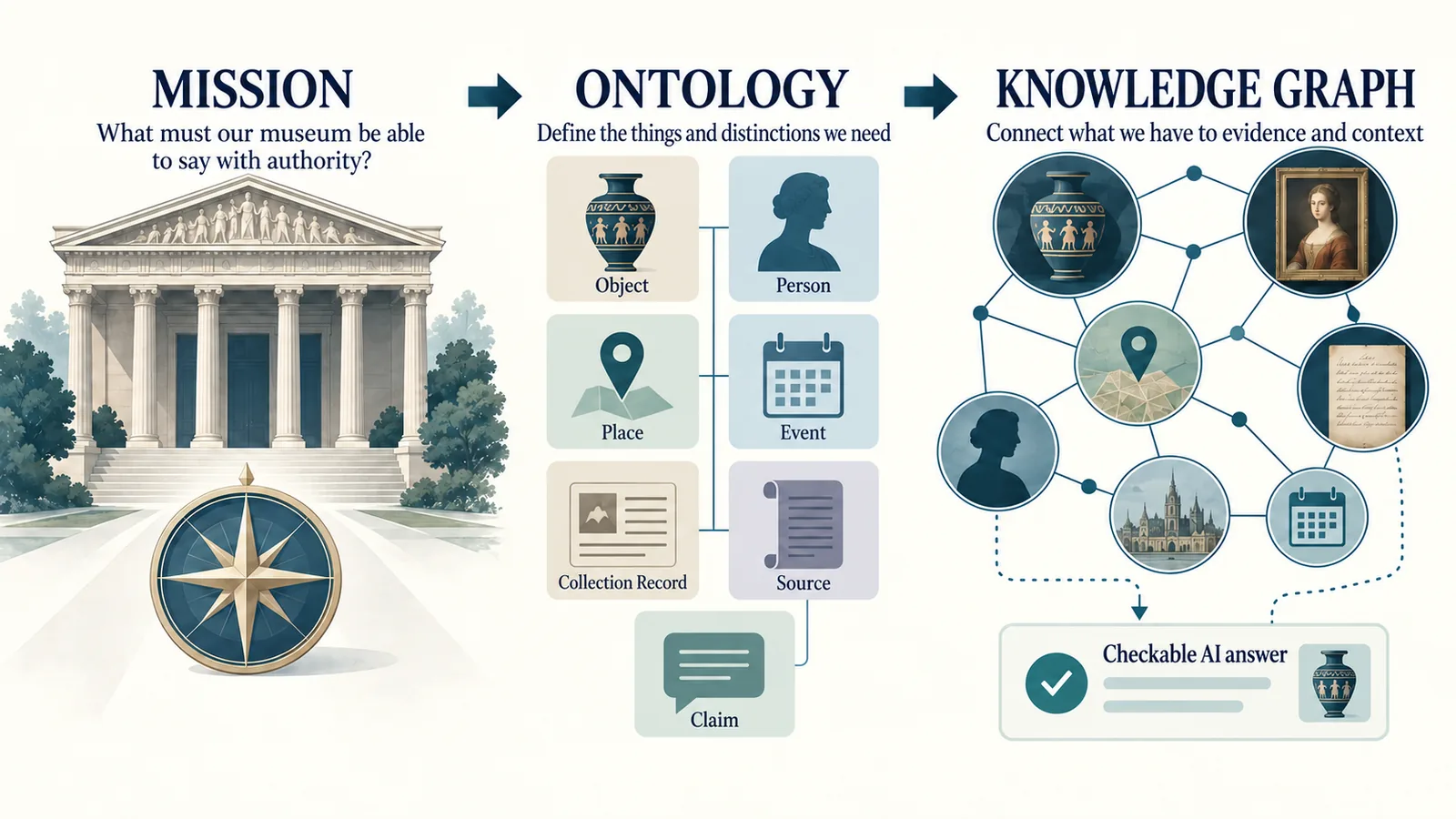
Mission defines the questions and responsibilities. Ontology defines the distinctions the institution needs to make. The knowledge graph connects records, people, places, events, claims, and sources. Evidence and provenance make each path inspectable. AI can then answer from a governed knowledge layer - and expose the path behind the answer.
Museum AI should inherit the epistemic discipline of museums: cataloguing, provenance, authority control, curatorial judgement, evidence, and attribution.
5.What we propose
We propose to design and build a mission-driven ontology and knowledge graph over the collection you already have - not a replacement for your collections management system, but the layer that makes it defensible to put AI in front of it.
The five principles below operate as one system. Together they answer the failure modes described above.
- Every statement is a claim until a witness confirms it.Each assertion records who said it, the evidence, date, status, and degree of corroboration. File-level provenance can be carried by C2PA / Content Credentials; statement-level provenance is the layer added above it.
- Identity must be decided, not left blurred.Authority control uses persistent identifiers and an accountable issuing authority, reconciled where useful against VIAF, Wikidata, or ORCID. A name may refute a match; it cannot by itself confirm one.
- Internal consistency is not truth.A valid record can still be wrong. The evidence hierarchy begins with what the institution directly holds and observes, then independent corroboration; internal consistency is a filter, and AI output enters only as a claim.
- Silence is the enemy - the system must fail loudly.A step that did not run, a record that was not saved, or an answer that lacks evidence must be visible. System status and uncertainty are reported, not hidden behind plausible language or an unexplained score.
- The map must admit its holes.Known absences, exclusions, disputed descriptions, undigitised material, and incomplete coverage are first-class metadata. Precisely stated gaps strengthen trust and prevent absence from being misread as evidence.
One principle without the others is not enough. Provenance without identity can trace the wrong entity. Identity without gaps can imply false completeness. A loud failure without evidence still leaves no route to resolution.
6.Claim-level provenance: what checkable means
C2PA and Content Credentials can help carry provenance for a digital asset. The Neo Gens layer complements that work by recording provenance at the level where institutional answers are made: the claim.
| AI answer | "Object X was created in Bangkok in 1957." |
|---|---|
| Claim 1 | Object X · createdAt · Bangkok |
| Claim 2 | Object X · creationDate · 1957 |
| Evidence | Catalogue record · Curatorial note · Archival source |
| Responsibility | Source · responsible agent · date · status · review history · known dispute |
Why a graph, and why now
A database can retrieve a record. A graph can also show how that record is connected to people, places, events, sources, and claims - and which paths of evidence support an answer. That makes the reasoning surface inspectable and correctable without forcing the institution to flatten its knowledge into one table or one narrative.
MuseKG demonstrates the working pattern: a typed property graph over museum collections, with provenance as a primary relation category, grounding natural-language questions to graph entities and retrieving a compact neighbourhood of evidence.
The vocabulary is mature enough to begin now. CIDOC CRM (ISO 21127:2023) provides semantic interoperability; Linked Art makes it practical for art collections. We use standards where they serve, extend them only where the mission requires, and document every extension and its rationale.
7.What happens next: a bounded pilot
The first engagement should be small enough to inspect and consequential enough to teach. It begins with a defined subset of the collection and a defined set of questions the institution needs to answer with authority.
- Collection subset
- Mission workshop
- Priority questions
- Ontology mapping
- Identity reconciliation
- Provenance model
- Working graph
- AI interrogation
- Curator evaluation
Pilot outputs: a documented mission model; agreed priority questions; mapped entities, claims, and relationships; an identity and provenance policy; a working graph; an interrogation prototype; and an evaluation record showing where the method succeeds, fails, or needs revision.
The decision at the end is evidence-based: stop, refine, or scale. No institution should commit to a multi-year programme before seeing the method work on its own material.
8.What we do not claim
- This is not a digitisation programme or a metadata clean-up service. Thin records and unresolved inconsistencies will become more visible, not less.
- This does not make AI accurate. It makes AI checkable. The distinction is the value: an answer can be traced, contested, corrected, and improved.
- A graph does not replace curatorial authority. It gives that authority a structure in which its evidence, decisions, uncertainty, and limits can travel with the answer.
- Standards are foundations, not substitutes for mission. We use shared vocabularies to interoperate, while preserving the distinctions your institution is responsible for making.
In three sentences
- The sector's own institutions - UNESCO, ICOM, the Library of Congress, and OCLC - have stated the problem: AI is entering collection workflows faster than the provenance practices that made those workflows trustworthy can adapt.
- The answer is a knowledge layer that records what is known, how it is known, and where it remains uncertain, so that every AI-produced answer can be traced to institutional evidence or clearly identified as a claim.
- Neo Gens designs and builds that layer with you, beginning with a bounded pilot and a mission-led model of what the institution must be able to say with authority.
AI can generate language. A knowledge architecture can make its institutional basis visible.
What your institution must be able to say with authority is the one question no model can answer for you.
Noppadol Weerakitti · noppadol@neogens.co · neogens.co
References
- Murray, K. & Sternfeld, J., Content Authenticity and Provenance in the Age of Artificial Intelligence, Library of Congress / C2PA for G+LAM, 2026.
- UNESCO & ICOM, Global Survey on the Use of Artificial Intelligence in Museums, 2026; American Alliance of Museums, AI in Museums and Community Trust, 2026.
- OCLC Research Library Partnership, Managing AI in Metadata Workflows Working Group; Library of Congress, Cataloging of Resources Generated Using AI Software - FAQ.
- American Alliance of Museums, Curatorial Chatbot: An Experiment with AI at the Nasher Museum of Art; US National Archives, AI-assisted name extraction.
- Yale University, LUX cross-collection discovery platform; Oxford e-Research Centre, Semantic Completeness vs Data Usability.
- Canning, E., Defining an Ontology for Museum Critical Cataloguing Terminology Guidelines.
- MuseKG: An Interactive Knowledge Graph Over Museum Collections, SIGIR '26; CIDOC CRM, ISO 21127:2023; Linked Art profile.
- From Fluent to Verifiable: Claim-Level Auditability for Deep Research Agents, arXiv, 2026; Web Archives Metadata Generation with GPT-4o, arXiv.